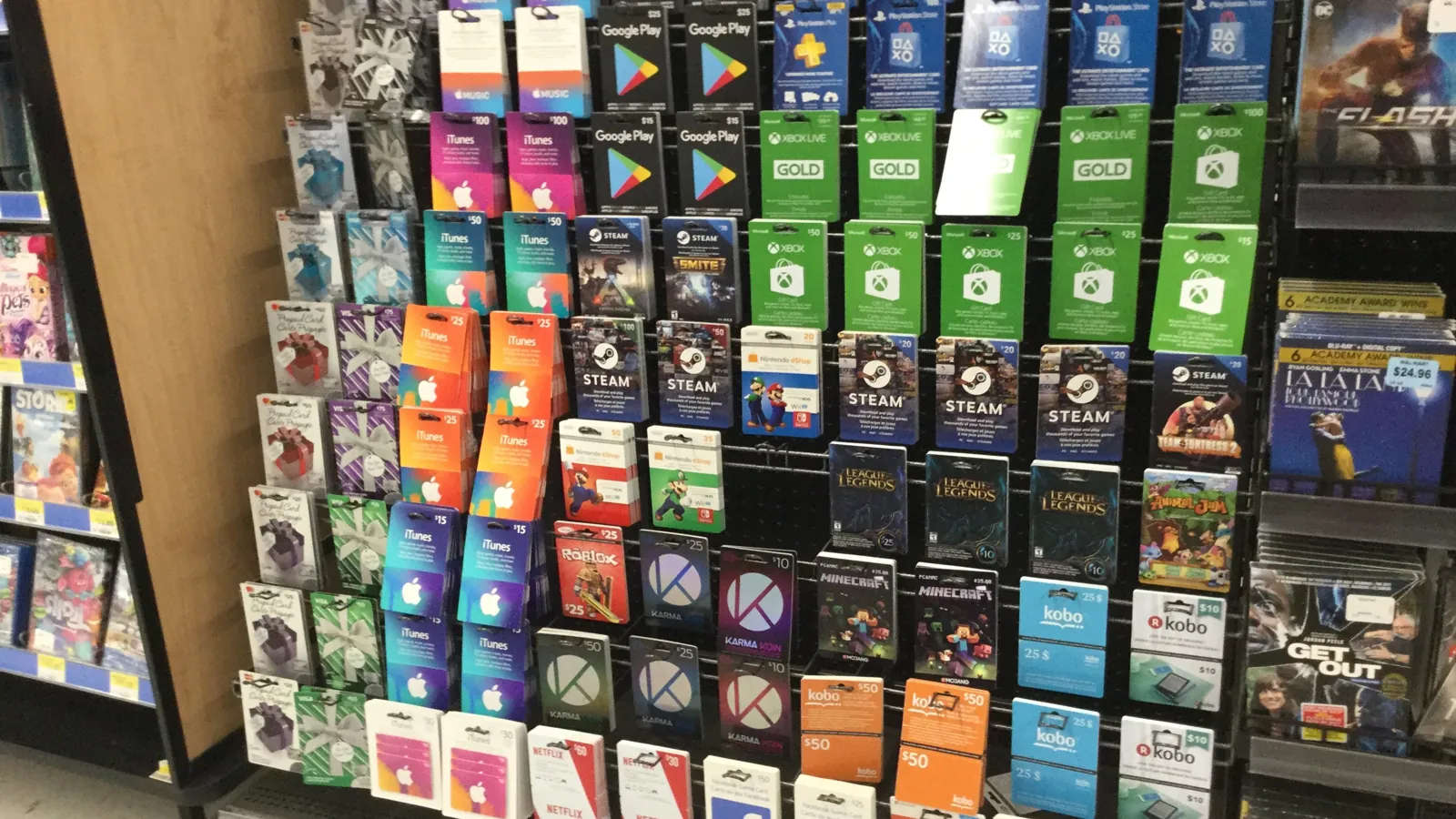
A gift card looks simple: a piece of plastic or an email with a value on it. Behind it sits an account held by the company that issued the card. The card itself is only the key to that account. Understanding that one idea explains most of what can go right and wrong with gift cards, from why a card bought from a rack is safe to leave in a drawer, to why reading the code out to a stranger means the money is gone.
The two families of gift card
Almost every gift card belongs to one of two families.
Store gift cards, sometimes called closed-loop cards, are issued by a retailer or brand and can only be spent with that brand. A Walmart gift card is spent at Walmart, a Starbucks card at Starbucks, an Amazon gift card on Amazon. The brand keeps the money from the moment the card is bought, which is why these cards rarely carry any fee.
Prepaid network gift cards, sometimes called open-loop cards, carry a Visa, Mastercard or American Express logo. They can be spent at almost any shop or website that accepts that network. Because the issuing bank earns nothing from a particular shop, it charges for the card: usually a purchase fee of a few dollars on top of the amount loaded.
Store gift card
Prepaid network gift card
Where it works
One brand, sometimes a family of brands
Almost anywhere the card network is accepted
Purchase fee
Usually none
Usually a few dollars per card
Expiry
Often never
The plastic has an expiry date; the funds are protected for longer
Good for
Someone you know shops there
Someone whose tastes you do not know
Online use
Enter the number and PIN at checkout
Often needs registering with a postcode first
There is also a third, smaller group: multi-brand cards, which can be exchanged for a choice of store cards, and restaurant or experience cards that work across a group of businesses. They behave like store cards with a longer list of places.
What happens at the till
A card on a rack is not yet worth anything. It becomes money at the moment the cashier scans it and you pay. That step is called activation, and it links the amount you paid to the number on the card.
Two practical points follow from that.
- Keep the receipt. The activation receipt is the proof that the card was paid for and for how much. If a card turns out to be empty, the receipt is what the store or the issuer will ask for. Give it to the person receiving the card, or keep it until they confirm the card works.
- Check the packaging before you pay. The scratch-off strip over the PIN should be intact and the packaging unopened. A card that has been tampered with can be drained by someone else the moment you activate it. Our guide to keeping gift cards safe explains what to look for.
Digital cards are activated automatically when the payment goes through. The code arrives by email or in an app, usually within minutes, though a first purchase from a new account can be held for a short check.
The number and the PIN are the money
Whoever holds the card number and its PIN or security code can spend the balance. There is no signature and no name on most store cards. That makes gift cards convenient as presents and also makes them attractive to fraudsters, who ask victims to buy cards and read out the numbers.
A rule with no exceptions. No genuine company, government office, bank or employer takes payment in gift cards. Anyone who asks you to buy a gift card and send them the code is committing fraud.
Treat a gift card like cash that happens to be traceable only by the issuer. Do not post a photo of the back of a card. Do not send codes by message to anyone except the person you intend to give the money to.
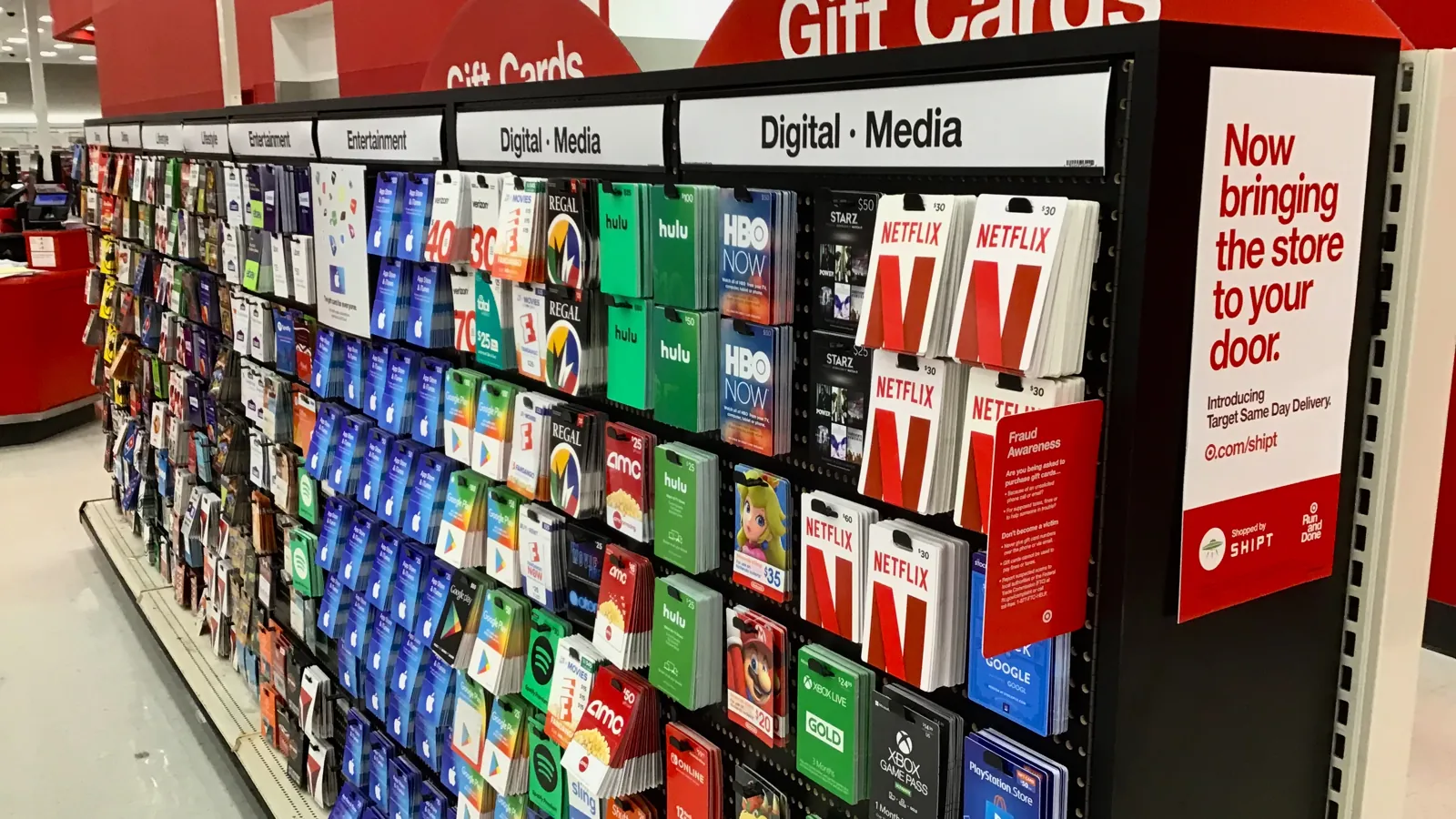
A gift card aisle in a large store. The cards are worthless until one is paid for and activated. Photo: Mike Mozart from Funny YouTube, USA, CC BY 2.0, via Wikimedia Commons.
Fees and expiry
Rules differ by country, and the card's own terms always apply. In broad terms:
- In the United States, the money on a gift card has to remain usable for at least five years from the date it was bought or last loaded, and inactivity fees are restricted. Many large retailers go further and state that their cards never expire and have no fees. Some states add their own protections.
- In the United Kingdom and much of Europe, there is no single minimum. Many store vouchers expire after one to two years, and the date is printed on the card or stated in the email. Check it when you receive the card.
- Prepaid network cards have an expiry date printed on the front, like a bank card. That is the date the plastic stops working. If money is left, the issuer can usually send a replacement, sometimes for a fee.
The most common way people lose money on gift cards is not fees or fraud. It is forgetting. A card put in a drawer is easily lost, and small leftover balances are often never spent. Our guide to using a gift card well covers how to avoid that.
If the shop closes
A store gift card is a promise from a company. If that company goes out of business, the promise may not be honoured, or only for a short period. This is rare with large retailers and worth remembering with small ones. A card for a business in difficulty is best spent soon.
Choosing between the two families
- Pick a store card when you know where the person shops. All of the money reaches them, and nothing is lost to fees.
- Pick a prepaid network card when you do not know their tastes or want to give something close to cash. Accept the purchase fee as the price of flexibility.
- Consider sending money directly through a payment app when the person already uses one. Our guide to sending money as a gift compares the main apps.
The next guide looks at the other choice every buyer faces: digital or physical.
Questions readers ask
Can a gift card be turned back into cash?
Usually not. Most store cards state that they cannot be redeemed for cash except where the law requires it. Some US states require a retailer to pay out a small remaining balance in cash on request.
Can I use a gift card to buy another gift card?
Most large retailers block this. Walmart, Target and Amazon all restrict using their own gift cards to buy other gift cards.
Does the card have to be used in one go?
No. The balance stays on the card until it is spent. Ask for the remaining balance to be printed on the receipt, or check it on the issuer's website.
Is a gift card the same as a gift certificate or voucher?
In everyday use, yes. A paper voucher works the same way, with a code in place of a magnetic stripe. The same care applies.